
Condom Sizes in Australia
Choosing the right condom size in Australia can feel like guesswork. When labels like “regular,” “close fit,” or “large” don’t reflect actual measurements, it’s easy to end up with a product that is uncomfortable, slips, or breaks.
If you’ve ever wondered how to work out the actual size of the condom inside the packet, you aren’t alone. This guide breaks down what the millimetre (mm) number on the box means, how nominal width works, how to measure yourself, and how to find a fit that keeps you safe and comfortable.
When browsing the pharmacy shelf, you’ll see terms like:
-
Regular / Original
-
Close Feel / Snug
-
Large / Extra Large
These terms sound helpful, but they are not standardized. A “regular” condom from one brand might be 54 mm wide, while another brand’s “regular” might be 56 mm. Because of this, marketing labels tell you very little about how the product will actually fit your body.
To find a size that fits properly, you need to look past the marketing and find the millimetre (mm) measurement printed somewhere on the box. In Australia, every approved condom brand including Durex, LifeStyles, Four Seasons, and Glyde display this number.
This measurement is called the nominal width.
What Does “Nominal Width” Mean?
Nominal width is the width of the condom when it is laid flat and measured straight across its open end (the base ring).
-
It is not length. Most condoms sold in Australia are more than long enough for the vast majority of people. Condom fit depends almost entirely on girth (circumference), not length.
-
It dictates tightness and comfort. If a condom feels painfully tight, causes numbness, or conversely, slips off easily during use, the issue is almost always the nominal width.
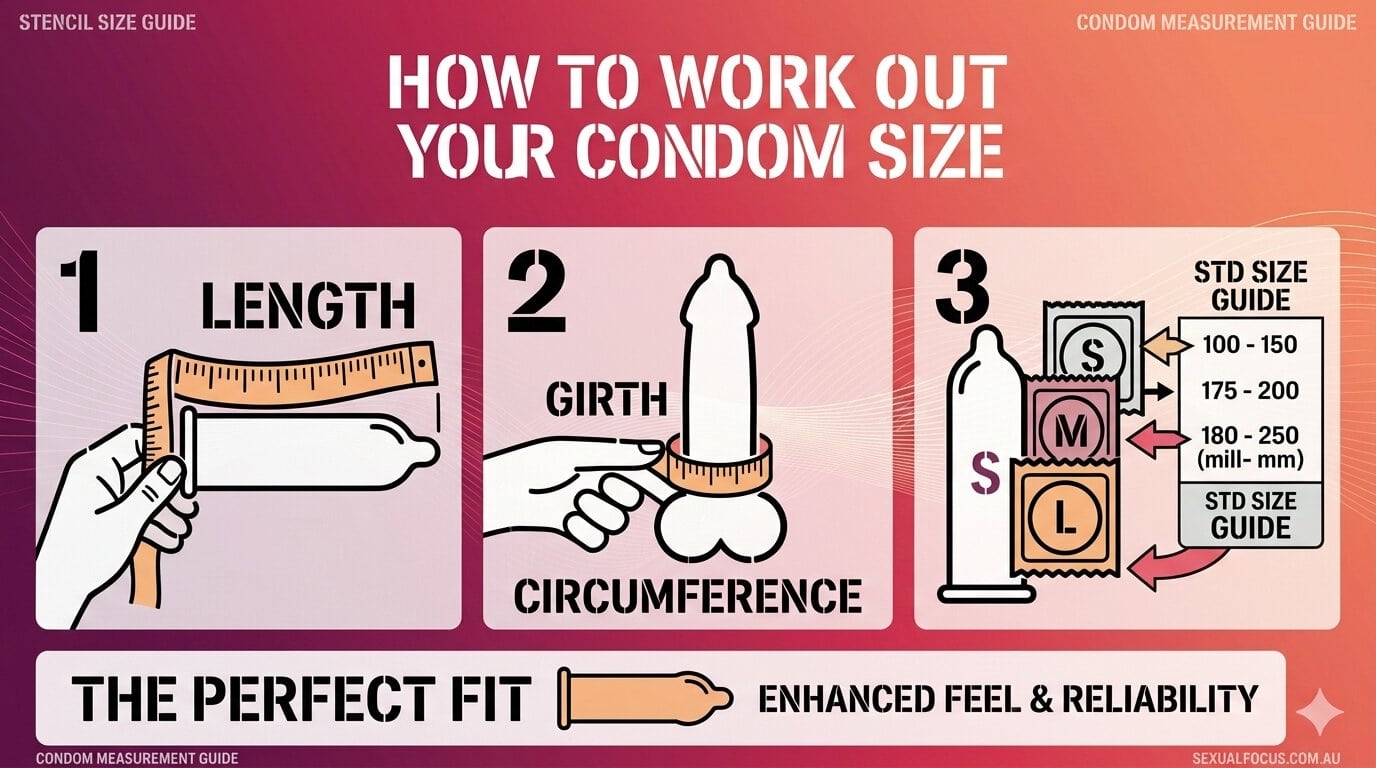
How to Work Out Your Size (A Simple Measuring Guide)
Before buying your next multi-pack, you can figure out your approximate nominal width using a simple calculation based on your girth.
-
Measure your girth: Use a flexible tape measure (or a piece of string and a ruler) to measure around the widest part of the erect penis.
-
Do the math: Nominal width is roughly equal to half of your circumference (girth), keeping in mind that latex and polyisoprene stretch to accommodate a snug fit.
-
Example: If your girth is around 110 mm, your ideal nominal width is roughly 55 mm.
-
Australian Condom Size Comparison Table
To make your next pharmacy or online trip easier, here is how popular Australian condom brands line up by their actual nominal width (mm) rather than their marketing labels:
| Category | Nominal Width (mm) | Popular Australian Brand Examples |
| Snug Ultra-Slim
| 49 mm | Glyde Slimfit Four Seasons Naked Closer Fit |
| Slim Snug Fit
| 52 – 53 mm | Various snug-fit variants |
| Standard Regular
| 54 – 56 mm | LifeStyles Regular (54 mm) Four Seasons Naked Classic (54 mm) Durex Originals Regular (56 mm) Glyde Maxi (56 mm)
|
| Large / Wide
| 57 – 60 mm+ | LifeStyles Large (56–58mm range) Four Seasons Naked Larger (60 mm) |
Frequently Asked Questions (FAQ)
What happens if a condom is too tight?
When a condom is too narrow for your girth, it stretches past its intended structural limit. This significantly increases the risk of friction, tearing, or breakage during use. It can also restrict blood flow, causing discomfort or loss of erection.
What happens if a condom is too loose?
If the nominal width is too large, the condom lacks the necessary tension to grip securely. This creates a high risk of the condom slipping off or sliding down during intercourse, rendering it ineffective for barrier protection.
Do alternative materials change the fit?
Yes. Traditional latex stretches very easily. Non-latex materials (like polyurethane) are much less elastic, meaning getting the exact nominal width right is even more important for comfort. Polyisoprene sits somewhere in the middle, offering a stretch closer to natural latex.
Learn more about our Sex Therapy and Counselling Services in Perth or book a confidential session with Fai Kur.
